


She’s sold out stadiums on six continents, broken every streaming record imaginable, and turned the Eras Tour into a cultural event that economists actually studied. But Taylor Swift’s greatest trick might not be the sequined outfits, unmatched songwriting or the friendship bracelets‚ it might be the fact that she’s been quietly in conversation with the theatre for nearly two decades.
These aren’t loose literary nods or vague thematic echoes. The nine connections below are rooted in actual plays, musicals, and in one case, a collaboration with one of the West End’s most legendary composers. Swift grew up seeing Broadway shows in her home state of Pennsylvania, and she’s never really left the theatre.
Here’s the proof.
1. Romeo & Juliet, Love Story (2008)

Let’s start at the balcony.
“Love Story” is so thoroughly soaked in Shakespeare’s most famous tragedy that it practically needs a period costume. Swift positions herself as Juliet, her love interest as Romeo, and her father’s disapproval as the Montague-Capulet feud made suburban. The balcony scene, the midnight garden visits, the forbidden courtship ‚Äî it’s all there, borrowed scene by scene from one of the most performed plays in theatre history.
And then Swift does something genuinely interesting: she rewrites the ending. Shakespeare’s teenagers die. Swift’s get engaged. The director of the Globe might wince; the radio stations did not.
The lyric: You were Romeo, you were throwing pebbles / And my daddy said, ‘Stay away from Juliet’
2. Hamlet, The Fate of Ophelia (2025)

If “Love Story” was a gentle wave at Shakespeare, Swift’s most recent Hamlet nod is a full stage dive.
The lead single from her 2025 album The Life of a Showgirl takes the tragic figure of Ophelia, Hamlet’s doomed love interest, who descends into madness and drowns after her father’s murder‚ and uses her as a mirror for Swift’s own past. The song describes a narrator rescued from that same fate of “insanity,” “drowning,” and “purgatory” by a devoted partner.
What makes it genuinely sophisticated is the bridge. It directly quotes Hamlet Act I, Scene III‚ Ophelia’s own line to her brother Laertes, “Tis in my memory locked, and you yourself shall keep the key of it”‚ remixed into Swift’s lyric “‘Tis locked inside my memory / And only you possess the key.” That’s not a reference. That’s a citation.
The lyric: The eldest daughter of a nobleman / Ophelia lived in fantasy / But love was a cold bed full of scorpions / The venom stole her sanity”
3. Othello, Willow (2020)

Swift’s Shakespeare fascination extends well beyond the tragedies she references by name.
On the folklore fan-favourite “Willow,” scholars have drawn a compelling line to Othello‚ specifically to Desdemona’s devotion to a scarred, complicated man, and to the “Willow Song” that Desdemona sings in Act IV before her death. The imagery of eloping, of following a beloved against all reason, of scars earned and wounds carried, maps quietly but deliberately onto one of Shakespeare’s most jealousy-soaked plays.
Swift has never confirmed it. She doesn’t need to.
The lyric: Show me the places where the others gave you scars / Now this is an open-shut case
4. All’s Well That Ends Well, Lover (2019)

Sometimes Swift quotes Shakespeare so directly it practically needs a footnote.
In “Lover,” the line “All’s well that ends well to end up with you” lifts the title of Shakespeare’s comedy wholesale, a play built on the idea that a messy, painful journey is redeemed by where it lands. Swift uses it as a declaration of love. In a song about wanting to grow old with someone, the choice of that particular Shakespeare title, a play about earned happy endings, is precise, not accidental.
The lyric: All’s well that ends well to end up with you
Peter Pan, Cardigan (2020) & Peter (2024)

J.M. Barrie’s Peter Pan began as a stage play, first performed at the Duke of York’s Theatre in London in 1904, before it became the story the world knows. Swift has returned to it twice, and the gap between visits says everything.
In “Cardigan,” the line *”Peter losing Wendy”* does enormous work in three words: the particular grief of outgrowing someone who refuses to grow with you. Then, four years later on The Tortured Poets Department, she returned to Barrie’s world explicitly in “Peter”, this time writing from Wendy’s perspective with full, clear-eyed hindsight. The Lost Boys, the refusal to come back to earth, the shelf life of a fantasy. Barrie’s play has always been about the bittersweet nature of growing up. Swift turned it into a two-part breakup arc across four years of her career.
The lyric (Cardigan): Tried to change the ending / Peter losing Wendy
The lyric (Peter): Lost to the ‘Lost Boys’ chapter of your life
6. Chicago, Vigilante Shit (Eras Tour, 2023-2024)

This one lives in the performance, not just the song.
On the Midnights section of the Eras Tour, Swift and her dancers performed “Vigilante Shit” as a chair routine, burlesque-inflected, Fosse-indebted, red-lit and deliberately dangerous, that critics immediately recognised as a direct nod to the 1975 musical Chicago. The parallels run deep: the song’s themes of female vengeance, white-collar crime, and cool-headed retribution mirror the show’s “Roxie Hart energy” almost beat for beat. Swift herself called it her favourite moment of the entire tour.
The musical Chicago has one of the most celebrated chair numbers in theatre history. Swift knew exactly what she was doing.
The lyric: While he was doing lines / And crossing all of mine / Someone told his white collar crimes to the FBI
7. Cats, Beautiful Ghosts (2019)

This is perhaps the most direct theatrical connection in Swift’s entire catalogue ‚Äî because she walked into it, literally.
In 2019, Swift co-wrote and performed in the film adaptation of Andrew Lloyd Webber’s legendary West End musical Cats, playing the role of Bombalurina. More significantly, she co-wrote an entirely new song for the film with Lloyd Webber himself, “Beautiful Ghosts”‚ a ballad that functions as a counterpoint to Cats‘ most famous number, “Memory.” Lloyd Webber later described it as “one of the finest collaborations of my 50-year career,” and the song earned Grammy and Golden Globe nominations for Best Original Song.
Cats premiered on the West End in 1981, ran for 21 years, and has been seen by 81 million people worldwide. “Beautiful Ghosts” is Taylor Swift writing from inside that legacy.
The lyric: And if everything I have is someday just a beautiful ghost / Then I’ll leave you with this as my final gift to you
8. The Showgirl Tradition, The Life of a Showgirl (2025)

The most personal theatrical reference Swift has ever made. Because this time, the stage isn’t a metaphor.
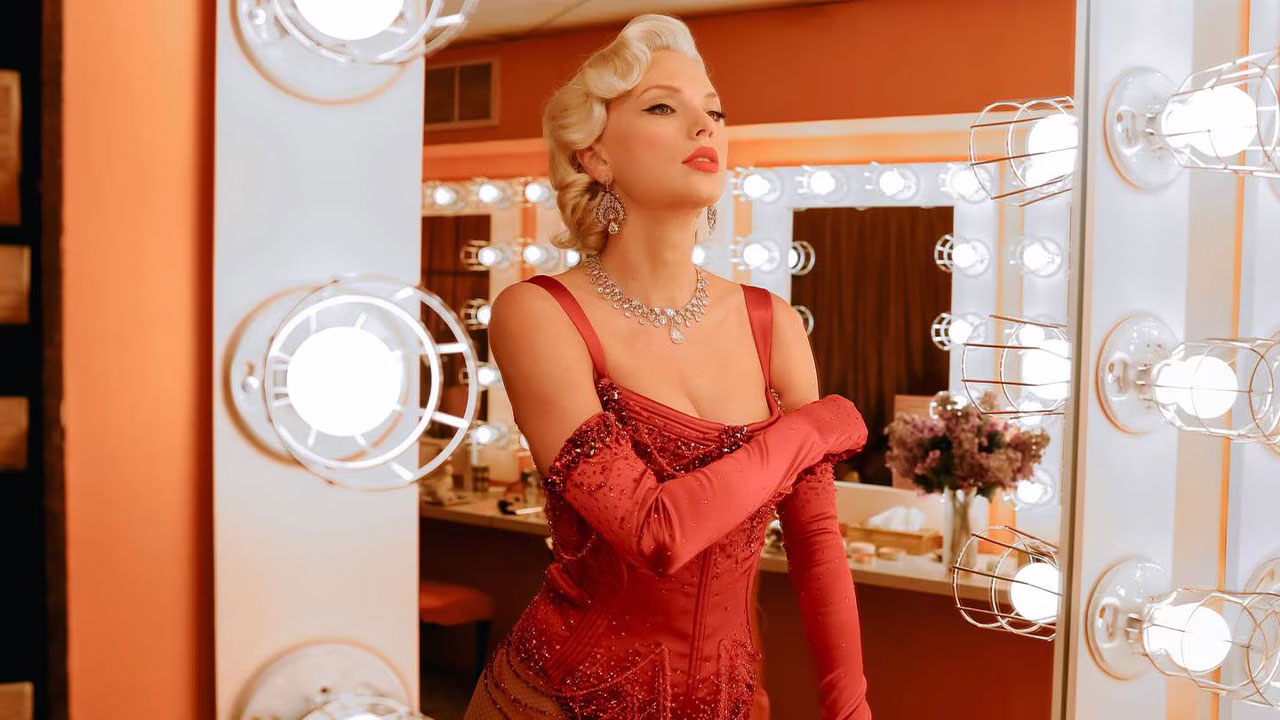
The title track of her 2025 album is an ode to the showgirl as archetype, the woman who performs her heart out, night after night, and learns to live inside the life the stage demands. It’s a lineage that runs from the Ziegfeld Follies to Cabaret to Chicago, from Sarah Bernhardt to Marlene Dietrich to Judy Garland. Swift, in the song and the album’s entire visual world, places herself consciously inside that tradition. The music video for Ophelia opens inside the foyer of the Los Angeles Theatre, cycling through Ophelia, a burlesque performer, a 1960s go-go dancer, a stage actress in the style of Sarah Bernhardt.
The lyric: I’m married to the hustle / And now I know the life of a showgirl, babe / And I’ll never know another
9. Who’s Afraid of Virginia Woolf?, Who’s Afraid of Little Old Me? (2024)

Edward Albee’s 1962 Broadway play, a savage, claustrophobic study of a marriage tearing itself apart over the course of a single evening, gave Swift one of the most pointed title lifts in her entire catalogue.
The reference operates on two levels at once. The Albee play itself uses the phrase “Who’s Afraid of Virginia Woolf?” as a taunt, a dare to confront raw, uncomfortable truth, and Swift repurposes that dare as a declaration. Where Albee’s characters use cruelty as intimacy, Swift uses the same energy to turn years of public scrutiny back on the people who enjoyed watching her squirm. But there’s a second layer: Swift has long been fascinated by Richard Burton and Elizabeth Taylor, who starred in the legendary 1966 film adaptation and were arguably the first celebrity couple to be consumed by the same media machine Swift has spent her career navigating. She referenced Burton and Taylor explicitly in “…Ready For It?” back in 2017, and has since in “Elizabeth Taylor”… duh. Returning to the world of Virginia Woolf feels less like coincidence and more like a conversation she’s been having with herself for years.
Albee’s play asks who is afraid of a writer who told the truth about what she felt. Swift’s answer, delivered from the gallows: you should be.
The lyric: So I leap from the gallows and I levitate down your street / Crash the party like a record scratch as I scream / ‘Who’s afraid of little old me? / You should be
The Bigger Picture
What connects all eight of these moments, across 20 years and 12 albums, is a writer who has always understood that the best stories are performed, not just told. Swift grew up watching Broadway shows in Pennsylvania, and she’s said in her own words that theatre taught her to think in scenes, in characters, in costume changes. That instinct never left her.
From a balcony in Verona to the foyer of the Los Angeles Theatre, she’s been on stage the whole time.

